
Is It Legal to Export Instagram Followers? Safe, Privacy-Aware Methods Explained
Last Updated: June 2026 | Reading Time: ~12 min |
Before most people choose an Instagram follower exporter, they ask the same question: is it actually legal to export Instagram followers?
It is a fair question. Automated collection of public web data can sound technical and risky, and social platforms have sued companies over how data was accessed. But the real answer is more specific than a simple yes or no.
The legal and privacy risk depends on three things:
- What data is being exported
- How the exporter accesses that data
- What you do with the exported followers list afterward
This guide explains the practical legal line between lower-risk public-data exports and higher-risk automated collection methods, using current U.S. case law, platform-term issues, and GDPR-style privacy principles.
Legal note:
This article is for general education only and is not legal advice. Laws vary by jurisdiction, change over time, and depend heavily on the details of how a tool works. If you are building a business around large-scale data collection or using exported data for regulated activity, speak with a qualified attorney.
Quick Answer
Exporting Instagram followers is not automatically illegal. A public-data-only workflow that does not require an Instagram password is generally much lower risk than a workflow that logs in, uses fake accounts, bypasses access controls, or tries to export private follower data.
The safer pattern looks like this:
- Publicly visible data only
- No Instagram password
- No fake, shared, or borrowed accounts
- No attempt to bypass private profiles or login walls
- Clear privacy policy and retention rules
- Responsible use of the exported data
The risky pattern looks like this:
- Logging into Instagram through automation
- Using fake accounts to view more data
- Collecting private or permission-restricted data
- Ignoring platform limits or technical blocks
- Storing large datasets without a clear purpose
- Using exported data for spam or non-compliant outreach
The difference matters because U.S. anti-hacking law, contract law, and privacy law do not all ask the same question.
Risk Matrix: What Kind of Export Are We Talking About?
| Scenario | Example | Relative Risk | Why It Matters |
|---|---|---|---|
| Public, logged-out data | Exporting public profile information visible without signing in | Lower | Current U.S. CFAA case law treats public web access differently from unauthorized access to restricted systems. |
| Your own account data | Downloading or organizing data from an Instagram account you control | Lower to moderate | You have account access, but privacy, retention, and later use still matter. |
| Logged-in automation | Running a bot through an Instagram session | Moderate to high | Platform terms, account enforcement, and anti-automation controls become more relevant. |
| Fake or shared accounts | Creating accounts to view more follower data | High | This pattern has appeared in real disputes and is much harder to defend. |
| Private or restricted data | Exporting followers from private accounts without permission | High | This crosses the clearest access and privacy boundary. |
| Large-scale resale or enrichment | Stockpiling follower data for resale or broad profiling | High | Privacy, consumer protection, and platform-contract issues become more serious. |
The Core Legal Line: Public Data vs. Behind the Login Wall
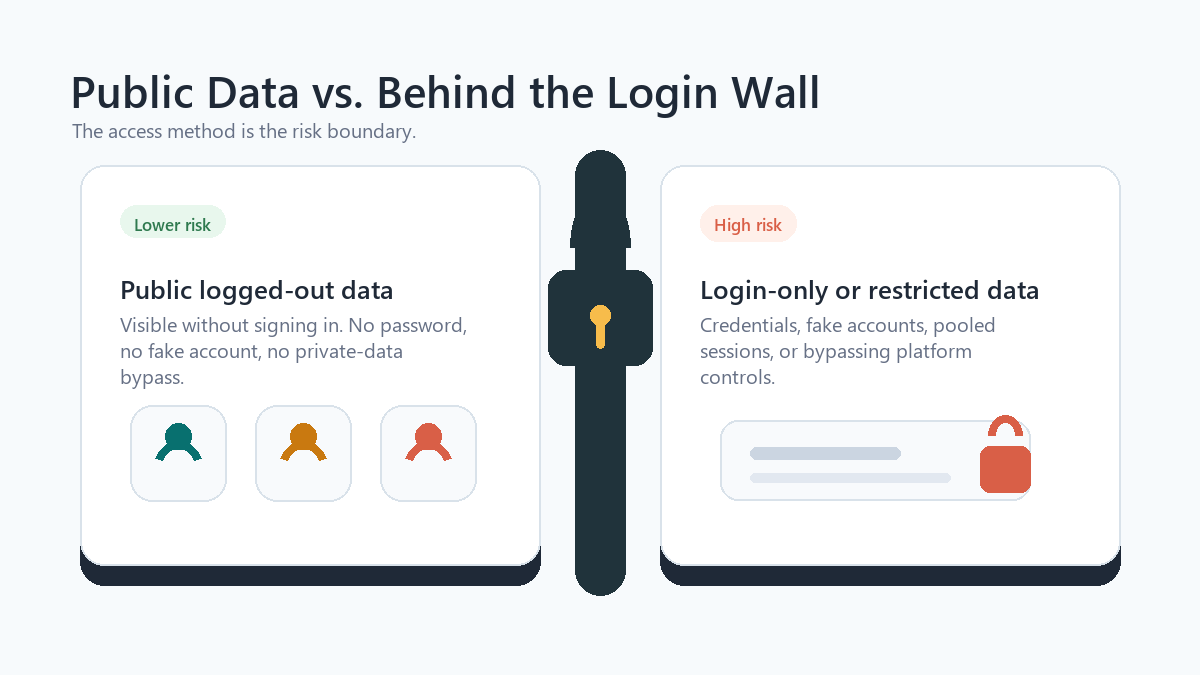
The most useful way to evaluate an Instagram follower export is not by the product label. The more important questions are whether the data is public and how it was accessed.
If data is visible to a logged-out visitor, the access pattern is generally lower risk under U.S. anti-hacking case law. If data requires logging in, using credentials, creating fake accounts, or bypassing technical barriers, the risk increases sharply.
That distinction does not make every public-data export automatically legal everywhere. It simply explains why a no-password, public-data-only Instagram follower exporter sits in a different risk category than a tool that asks for your Instagram login.
U.S. Anti-Hacking Law: What hiQ v. LinkedIn Actually Says
The main U.S. law platforms have historically used to challenge automated collection is the Computer Fraud and Abuse Act, commonly called the CFAA. It is a federal anti-hacking statute that prohibits accessing protected computers "without authorization."
For years, courts and platforms debated whether continuing to collect data from publicly available web pages after receiving a cease-and-desist letter could count as access "without authorization."
The most cited case is hiQ Labs v. LinkedIn.
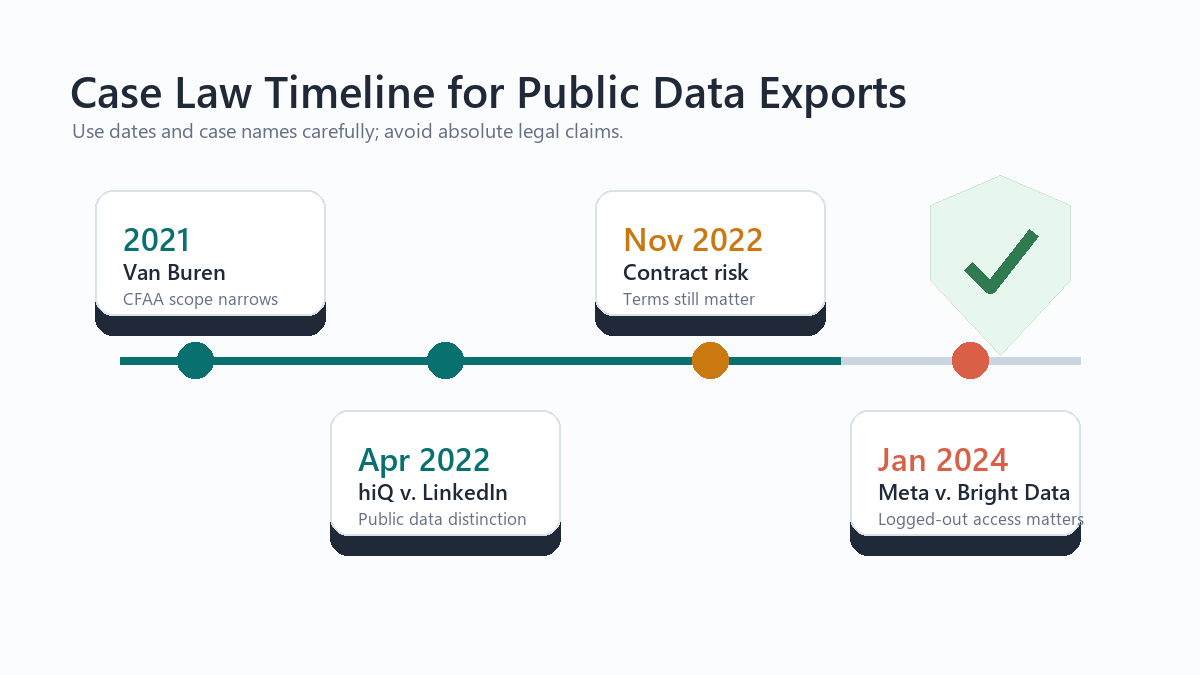
hiQ collected public LinkedIn profile data and used it for analytics products. LinkedIn sent a cease-and-desist letter and argued that continued automated collection violated the CFAA. In 2022, after the Supreme Court's Van Buren v. United States decision narrowed part of CFAA interpretation, the Ninth Circuit again held that hiQ had raised serious questions about whether LinkedIn could use the CFAA to block access to publicly available profiles.
The practical takeaway is narrow but important:
CFAA takeaway:
Public web pages that do not require authentication are treated differently from password-protected or access-restricted systems. In the Ninth Circuit, collecting public data is harder to frame as "hacking" under the CFAA.
This does not mean every automated collection method is legal. It also does not mean the rule is identical in every U.S. jurisdiction. The hiQ ruling was about a preliminary injunction and public LinkedIn profiles, not a blanket permission slip for any kind of social media data extraction.
The Part Many People Miss: hiQ Still Faced Contract Risk
Many summaries stop at "hiQ won against LinkedIn." That is incomplete.
The CFAA issue was only one part of the litigation. LinkedIn also pursued contract claims based on its User Agreement. In a November 2022 summary judgment order, the court addressed hiQ's conduct under LinkedIn's terms. The record included logged-in quality-assurance work by independent contractors known as "turkers," and the court noted fake-account activity after some accounts were restricted.
Then, on December 8, 2022, the court entered a consent judgment and permanent injunction.
The lesson for Instagram follower export is straightforward:
- Winning or avoiding a CFAA theory does not eliminate Terms of Service risk.
- Public-data access and logged-in/fake-account activity are not the same pattern.
- Contract claims can lead to injunctions, damages, account restrictions, or settlement obligations.
Practical takeaway:
The lower-risk pattern is not "export anything." It is public data, no social account connection, no fake accounts, no private data, and no aggressive bypassing of platform controls.
Meta v. Bright Data: Why Logged-Out Access Matters
In January 2024, a federal court ruled in favor of Bright Data in Meta Platforms v. Bright Data, a case involving Facebook and Instagram data.
Meta brought breach-of-contract claims. The court found that Meta had not shown Bright Data collected non-public data while logged into a Facebook or Instagram account. It also interpreted the relevant Facebook and Instagram terms as not prohibiting Bright Data's logged-off collection of publicly available data.
This was a contract case, not a CFAA ruling. Still, it reinforces a practical distinction that matters for Instagram follower exporters:
- Logged-out collection of public data is one category.
- Logged-in collection of restricted or non-public data is another category.
- Courts may examine the actual technical method, not just a product label.
Terms of Service Still Matter
Even if an export method does not look like hacking, platform terms can still matter.
Instagram and Meta can restrict automated collection, impose technical limits, suspend accounts, block traffic, or bring contract-based claims depending on the facts. A Terms of Service issue is different from a criminal hacking issue, but it is still a real business risk.
For users, the most important questions are:
- Does the tool ask for your Instagram password?
- Does it automate actions through your logged-in session?
- Does it use fake or pooled accounts?
- Does it try to access private or hidden data?
- Does it ignore rate limits or technical blocks?
- Does it clearly explain what it collects and stores?
If the answer to any of the first four questions is yes, the export workflow is no longer in the clean public-data-only category.
GDPR and Privacy: Public Data Can Still Be Personal Data
U.S. case law on automated data collection is only one part of the analysis. Privacy law asks different questions.
Under GDPR and similar privacy regimes, information can be personal data even if it was posted publicly. A public Instagram username, profile photo, bio, location, business category, email address, or profile URL may identify a person directly or indirectly.
That means public availability does not automatically give a company permission to process the data for any purpose.
If your business is in the EU or UK, offers goods or services to people in the EU or UK, or monitors behavior of people there, you may need to consider:
- Lawful basis for processing
- Purpose limitation
- Data minimization
- Retention period
- Transparency obligations
- Security of exported files
- Deletion or objection requests
For marketing and lead-generation use cases, companies often consider legitimate interests. But legitimate interest is not magic language. You still need to define the purpose, minimize the data, and balance your interest against the rights and expectations of the people in the exported list.
Privacy takeaway:
"Publicly visible" does not mean "free to store forever, enrich without limits, or use for any outreach campaign."
A Safer Instagram Follower Exporter: What to Look For
If you are evaluating an Instagram follower exporter, focus less on marketing claims and more on operational signals.
| Check | Safer Signal | Risky Signal |
|---|---|---|
| Instagram login | Does not ask for your Instagram password | Requires password, session cookie, or two-factor workaround |
| Account requirement | No tool account required or minimal account data | Requires unnecessary personal details |
| Data scope | Publicly visible data only | Claims to export private followers or hidden data |
| Collection method | Logged-out public-data workflow | Logged-in bot, fake accounts, pooled accounts |
| Output | CSV or structured export with limited fields | Massive unfiltered dumps |
| Retention | Explains deletion or short retention | No retention explanation |
| Privacy policy | Clear policy and contact method | No policy or vague claims |
| Rate behavior | Reasonable limits | "Unlimited" high-frequency collection claims |
The safest tools are usually the least dramatic. They do not promise private data, unlimited exports, or account-level automation. They explain the boundary of what they can and cannot access.
What Users Should Do Before Exporting a Followers List
Before you export Instagram followers, answer these questions:
- Is the source profile public?
- Can the data be viewed without logging in?
- Do I have a clear purpose for the export?
- Do I need every field, or only a smaller set?
- How long will I keep the file?
- Who can access the exported CSV?
- Will the data be used for outreach, enrichment, resale, or profiling?
- Do EU/UK privacy rules or other local laws apply?
- Can people request removal or opt out?
- Would I be comfortable explaining the collection method to a customer, partner, or regulator?
If you cannot answer these questions, slow down before exporting. The legal risk often comes less from the initial export and more from unclear purpose, excessive retention, or careless downstream use.
Safer Use Cases vs. Riskier Use Cases
| Use Case | Risk Level | Notes |
|---|---|---|
| Exporting your own account data for backup | Lower | Use official account-owner tools where possible. |
| Researching public profiles for audience analysis | Lower to moderate | Keep the dataset narrow and avoid sensitive inferences. |
| Building a small lead list from public business profiles | Moderate | Outreach rules and privacy expectations still matter. |
| Exporting competitor followers at scale | Moderate to high | Scale, retention, and platform terms increase risk. |
| Using fake accounts to view follower lists | High | This is a major red flag. |
| Exporting private followers without permission | High | Avoid this pattern. |
| Reselling or enriching large follower datasets | High | Privacy, contract, and consumer protection issues can stack. |
Where SoLeads.ai Fits
SoLeads.ai's Instagram follower export tool is designed around the safer pattern described in this article:
- Publicly visible data only
- No Instagram password
- No Instagram account connection
- No fake-account workflow
- No account required to try the tool
- Export-focused output for lead research and audience analysis
That does not mean every downstream use is automatically risk-free. How you store, enrich, share, and use exported follower data still matters. But the collection method avoids the biggest red flags: credentials, private data, fake accounts, and logged-in automation.
Positioning line:
Public data, no password, no fake accounts, no private-data bypass.
Compliance Checklist for Exported Follower Data
Use this checklist after exporting a followers list.
| Step | What to Do |
|---|---|
| Limit fields | Keep only the data needed for your stated purpose. |
| Record the source | Add the source profile and export date to your file. |
| Remove irrelevant records | Delete private, unrelated, or low-quality profiles. |
| Avoid sensitive labels | Do not infer sensitive traits unless you have a clear lawful basis. |
| Secure the file | Store the CSV in a controlled location, not a random shared drive. |
| Set retention | Decide when the export should be deleted. |
| Respect objections | Have a process for deletion, opt-out, or suppression requests. |
| Review outreach rules | If using the list for prospecting, check email, DM, and local marketing rules. |
Frequently Asked Questions
Is it legal to export Instagram followers?
Not categorically illegal, but not automatically risk-free. Public data accessed without logging in is generally lower risk than private, restricted, logged-in, or fake-account access. Terms of Service, privacy law, and downstream use still matter.
Is exporting public Instagram followers the same as hacking?
Not usually. U.S. CFAA case law, especially hiQ v. LinkedIn in the Ninth Circuit, treats public web data differently from unauthorized access to restricted systems. But that does not eliminate platform-term or privacy-law risk.
Can I export Instagram followers without giving my password?
For public data, yes. A public-data-only Instagram follower exporter should not need your Instagram password. If a tool asks for your password to export public data, treat that as a red flag.
Does Instagram's Terms of Service matter if the data is public?
Yes. Terms of Service can create contract-law exposure separate from anti-hacking law. They can also support account restrictions, technical blocking, or legal demands depending on the facts.
Does GDPR apply to public Instagram data?
It can. Publicly visible data can still be personal data under GDPR. If your business is established in the EU, targets people in the EU, or monitors their behavior, you may need a lawful basis and privacy safeguards.
Can my Instagram account be banned for using a follower exporter?
Account-level risk is much lower when you do not connect your Instagram account and do not run automation through a logged-in session. However, platforms may still block traffic, limit access, or challenge tools that collect data aggressively.
Is it safe to use a free Instagram followers tool?
Only if it is actually an export tool, not a follower-growth or fake-engagement tool. A safer free Instagram followers tool should avoid passwords, fake accounts, private data, and vague retention practices.
What is the safest way to use an exported followers list?
Keep the list narrow, store it securely, delete it when it is no longer needed, and use it only for a clear and lawful purpose. If you use it for outreach, check the rules that apply to your channel and jurisdiction.
Final Takeaway
The legal question around exporting Instagram followers is not answered by a product label. The better question is: what data, what access method, and what use?
The lower-risk pattern is clear:
- Public data
- No Instagram password
- No fake accounts
- No private-data bypass
- Limited retention
- Responsible downstream use
The higher-risk pattern is just as clear:
- Login automation
- Fake or shared accounts
- Private or restricted data
- High-frequency collection
- Unclear retention
- Spammy or non-compliant outreach
If you need to export Instagram followers for research or lead analysis, choose a privacy-aware Instagram follower exporter that stays on the public-data side of the line and gives you a clean, limited file you can manage responsibly.
Export Instagram Followers in Minutes
Download followers, following, public emails and contact info to CSV.